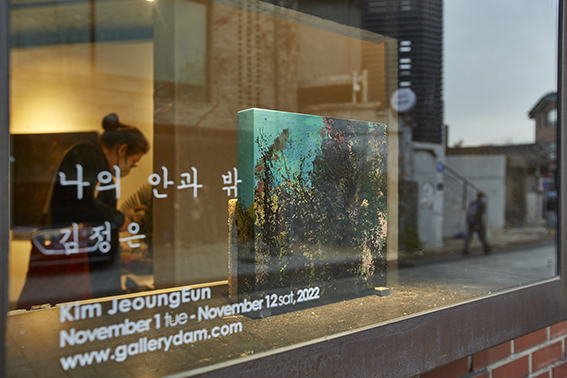
작가노트
삶과 죽음이 손가락 사이로 흘러내리고
시간이 눈을 타고 들어오고
입을 통해 관계가 맺어진다.
다른 작가와 작업에 대한 얘기를 할 때
난 그림에 대해 얘기하고 있었고 그녀는 예술작업에 대해 얘기하고 있었다.
그 간극을 알아챈 순간
’예술가’라는 단어는 낯설었고 ‘그림을 그리는 작가’라는 나의 위치를 이해하게 되었다.
문장을 이루는 단어의 해석은 사람의 경험치에 따라 범위도, 뜻도 제각각이다.
말하고 글을 쓴다는 행위는 내겐 넌센스처럼 느껴진다.
내가 던진 말들이 타인에게 온전히 전달될거라 생각하지 않는다.
하나의 덩어리로 보여지는 그림이 나는 편하다.
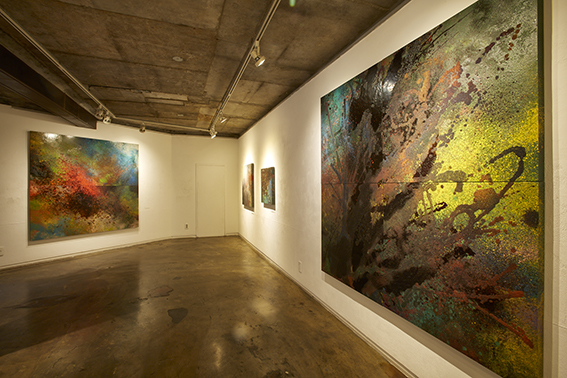
‘달에 꽃이 피었습니다.’ 제목의 작업은 이 생각에서 시작되었다.
삶의 여러 능선을 넘으며 알지 못했던 감정과 생각을 마주하게된다.
이전의 나와 이후의 나는 격변 하였을까?
.
.
.
그건 나의 근간이 되는 중심이 뒤집히는 것이 아니라 생각의 영역이 확장되고 감정의 깊이가 달라지는 것이었다.
나의 우주는 내 신체를 기준으로 안과 밖이 나뉜다.
내 안의 우주
내 밖의 우주
나에게 우주란 비어있는 가시적 공간이 아닌 무언가로 꽉찬 질량의 범위이다.
작가가 자신의 존재감을 갖기 위해서는 선택과 집중을 해야 한다고 얘기한다.
훌륭한 작업을 보면 앞선 작가들의 삶을 대하는 농축된 생각과 신념을 알 수 있기 때문이다.
아직 나에겐 집착할 유,무형의 대상이 강하게 대시 해오지 않는다.
그래서 현재 그릴 수 있는 그림을 그리는 완성형 작가가 아닌 진행형 작가이다.
나의 현재는 미지의 세계이며 접점이 모이기 힘든 평행선에 가까운 길을 가고 있다.
전에 나에게 물었다.
넌 무엇을 그리고 싶니?
지금 나자신에게 묻는다.
넌 무엇을 그릴 수 있니?
옻칠화_복원 예술과 트랜스-종의‘인공물’(artifact) 관한 큐레이션
심희정 (예술비평)
1. ‘인공물’의 사회 생활에 관한 고백
부딪칠까, 떨어질까, 애지중지하는 자연인에서 태어난 나는‘인공물’(an artifact)이다. 사물의 존재인 나는 삶과 죽음이 고이고 담긴 기물형상의 그릇이며, 나의 기원은 B.C 4 기경, 청동기 시대에 경상남도 창원시 덕천리에서 발견된 나무의 편린이다. 내 조상의 하양은 태초를 말하는 생명의 알이며, 검음은 죽음의 존엄을 비추는 달의 위엄이다. 청룡, 주작, 백호, 현무의 동서남북이 상하좌우로 이어진 이 서사시는 삶과 죽음이 하나의 그릇이요, 씨줄과 날줄의 짜임에 따른 삶의 끈기와 순응을 운명의 칠이라 불렀다고 한다.
2014년, 우리는 그녀의 삶이 담긴 정원이자, 삶의 방식인 짜임에서 태어났다. 나는‘미술품’운송차를 타고 순수 (fine) 갤러리(gallery), 공예(artcrafts) 및 민속 박물관(museum)에 간다. 그녀는 그때마다 나와 가족들을 부른다.
밤벚꽃, 어느날, 곶자왈, 조각풍경, 해뜨는 동산, 오름1, 오름2, 오름3, 산, 겨울산, 돌아가는 길, 낯선, 폐허, 부러진 나무, 방풍나무의 흔적, 제주의 풍경, 우울한 날, 길
성장해서, 놓인 그대로, 넘치지 않는, 오리엔탈,
휘몰아치는, 무거운 태양의 열대야,
가만히, 흐르는, 표피와 같은, 투둑 투둑투둑,
무념의 희망, 이카루스, 하얀밤바다,
요즘 우리 친족들은 몇몇 소식에 열을 올린다. 영국의 석유와 천연가스 추가 시추를 반대하는 환경단체인 '기름은 이제 그만'(just stop oil)의 활동가 두 명이 고흐의 (1888)에 토마토 캔을 부은 사건을 두고 말이다. (CBS, 2022.10.17.) 우리보다 가볍거나 무거운, 두껍거나 얇은 친족들이 앞다투어 나선다.
회화: “유명해서 힘들어”
“Covid-19가 끝나가서 갤러리와 미술관에 사람들이 많이 와,
우크라이나와 러시아 전쟁 때문에 사람들이 힘들어, 우리가 할 일이 많아”
조각: “글쎄, 사람들이 변했어”
판화: “영상의 시대야”
도예: “우리가 무겁대”
목가구: “우리를 좋아하는 사람들도 있어”
사진: “우리도 하향 산업이야”
덜커덩, 문이 열렸다. 몇몇 친족들이 자리를 뜨고 우리만 남았다. 아니 정확하게, 관객을 향해 어디로 갈지를 정하려는 여러 가설들의 법정인 큐레이터와 함께 말이다.
큐레이팅 1 : 관습대로 하지요? 공예인가요?
큐레이팅 2 : 사례대로 하지요? 아니 위상학적으로 회화에요?.
작가가 판화도 했는데요. 판이래요.
큐레이팅 3 : 뒷면도 있어요. 담김과 짜임 설치예요?
큐레이팅 4 : 왼쪽에 하나, 이렇게 걸리면 되겠네요 아니, 아니 오른쪽에도 하나
큐레이팅 5 : 캡션의 방향을 빛으로 할까요? 색으로 할까요?
큐레이팅 6 : 다른 작품들하고 흐름을 같은 방향으로 해요, 다른 방향으로 해요?
큐레이팅 7 : 얼마인가요?
큐레이팅 8 : 천연으로 할까요? 인공으로 할까요?
큐레이팅 9 : 어떤 비율로 할까요? 사실화적 의도에요? 추상화적 우연이에요?
어떤 쪽이 더 흥미로울까요?
큐레이팅 10: 재료가 다국적이에요? 한국적이에요?
큐레이팅 11: 옷이에요? 옻이에요? 어떤 언어를 응용할까요?
나는 문화적 인공물로서 사회적 관습 및 특징, 그리고 유형 및 사례의 전당인 뮤지엄의 지식을 따른다. 이것은 간단하면서도 복잡하다. 미술관의 문을 두드리는 어떤‘사물적인’,‘사물인 듯한’,‘사물마저도’박물관 및 미술관 큐레이션의 분류학적 지식의 의혹스러운 응시를 피할 수 없다. 사물형인 동형이나 이형이 말하기를, 우리가 용 되려면 사물의 품격인 성적, 사물인의 행위가 모너니즘 및 포스트 모더니즘의 규칙적 특성(regularity)에 안성맞춤이어야 한단다. 이것이 우리“사물의 사회적 생활”(The Social Life of Things)이며, 가끔“예술과 행위”(art and agency)사이에‘오브제’로 출현도 한다. 그러나 이것이 끝은아니다.
우리의 이상은 우주선 같은 변화와 지속의 자기 추진체가 되는 것이다. 이 말을 부정해서 대지에 잠들었던 동형 친족은 사람들이 깨운 이래, 지금까지 달라진 적이 한번 있을까 말까 한다. 그러나 이형 친족은 어찌나 반죽이 좋은지 우리도 못 알아본다. 그래도 이전의 사물형은 박물관에 자리도 있다. 그 다음 세대인 우리에게 교환이나 순환이 있을까. 우리의 사회 생활은 어찌 가능할ᄁᆞ. 아아, 통재라.
사람들은 세계를 좋아한다. 큐레이션의 세계적 가설이 크면 클수록, 낯설게 생긴 우리는 여기에 있는데, 사람들은 저기에 있다. 유명한 철학자가“부표처럼 떠다니는 나뭇가지의 예술”(조지 딕키)로 불렀을 때, 우리의 사회 생활이 존재적으로 승격된다고 생각했지만, 시간은 덥고 서늘한 곳에 사는 옻나무들도 하나, 둘 사라져 간다.
2. 옻칠화의 꽃피움에 관해서
생태 예술은 사물의 유형으로 발견되는 것은 아니다. 작가는 자연에 대한 경험이 우리의 일상 및 합리적 이해를 넘어서 자연과의 공감이 일어날 때 우연처럼 찾아오는 생의 약동을 이야기한다. 자신의 삶의 기쁨, 분노, 슬픔, 즐거움을 인정하고 승인하는 자신과의‘비껴보기’의 만남은 자연처럼 흐르는 다채로움이며, 자연 과정과의 공존에 대한 공감의 기록이다.
일반적으로 전통 공예에 속한 칠기에서 옷칠은 자연 천연 물질에서 비롯한다. 옷칠의 기반은 나전 칠기가 조선 시대의 아름다움을 대변할 뿐 더러, 동양의 사상적 조화가 미학적 관습률로 자리하면서이다. 칠기의 검음과 붉음의 조화, 목재의 숨결 같은 단단함과 단아함은 옻칠의 색결에 대한 우리 조상들의 사물의 세계를 깊이 연구하는‘궁리’(窮理)의 태도 및 방법을 지시한다. 이러한 조망은 20세기 후반에 판 드 리우(Van der Leeuw)(1993)의 연구를 선두로 한 공예성 및 공예품에 다가서는 원리를 제시했는데, 이는 넓은 의미에서 공예를 이루는 물질과 사회적 변화의 관계를 시사할 뿐 더러, 작가의 작품에 대한 이해에 도움을 준다.
이들의 접근은 수평 및 수직으로 보는 (지정학적) 위상학(the topology), 특정 형태의 부분 및 전체의 분류학(the partonomy=meronomy), 연속성(the sequence)이며. 풀이하자면 장소적 위상계는 사물의 놓이는 방식인 ‘펼침’과 ‘섬’의 수평률 및 수직률을 지시한다. 분류학적 위계는 부분과 전체의 관계율, 그리고 연속성은 배치율 또는 구성률을 이른다. 이는 칠기에서 해와 달을 닮은 얇은 펼침으로 원형의 반((盤)을 이르며, 논이나 밭과 같은 땅의 형태로 삼라만상의 물((物_things)이 담기는 상자인 궤((櫃)를 조형의 중심에 놓는다. 그리고 이 정원의 반과 정방의 궤의 형에 자연의 상을 다시 담은 것이 문양과 색이다.
옻칠은 기능적으로 물이 스미지 않는 방수와 부패 및 부식 방지의 효과에서 비롯했다. 자연의 성질을 이용한 태초의 지혜는 사회의 발달적 지층을 따라‘공예다움’의 기술적 기회들이 녹아있으며, 유용한 인공화의 증진 및 사물의 진화적 적응은 칠기의 소비 및 생산을 확정 짓는 원인이자, 제작 절차를 배양한다. 이 점은 21세기의 공예성의 출발이자, 사회와 물질 변화의 관계를 변화와 지속의 양상으로 수렴했다. 공예 기술은 안정화에 이르면, 사용과 경험을 고양하는 미감의 변주로 들어서는데, 미감을 작동하는 내재적 율동은 만일 형이 어느 지점에서 본래의 형을 유지하는 방향으로 충족 및 강화되면, 지금 여기를 지시하는 동시성의 방향에서 미감은 감소 될 위험을 갖는다고 한다. 미감의 내재율로서 옻칠의 과정적인 변화 및 지속의 궤도는 공예의 역사적 전통이 갖는 근본적인 요소들의 특정한 방식이라는 토대를 마련하며, 이는 문화 원형으로서 정신과 물질의 관계를 비추는 예술과 기술의 관계에 가늠을 시사한다.
위상, 위계, 연속, 이 세 가지 내재율은 공예가의 활동 영역에서 의식적이든 무의식적이든 공유될 뿐 아니라, 제작이 수반한 모든 단계들의 수 많은 기회의 총합으로 가정되어 칠기의 특정하고도 보편적인 양식들을 결과한다. 공예인들은 제조 과정에서 변화의 잠재적 가능성이라는 변주를 갖게 되는데, 기회는 모든 기법의 초기의 방법을 관습의 보존으로 간주하거나 이와 무관하게 변화들을 피운다. 옻칠 공예가들은 색에 관한 고유한 내재율을 꽃피움(색의 펼침)이라고 부르는데, 사회적 압력 또는 환경적 억제의 제약에도 불구하고, 이들은 공예가들의 능동적인 노력이다. 이 때문에 칠기를 비롯한 공예성은 다른 예술품과 다르게 사회의 서로 다른 속도와 스케일의 변화에 영향을 덜 받고, 오히려 인공물의 형식이 갖는 몇몇 구성 요소의 연속 작용을 관찰할 수 있다. 재료의 자연적 상태 및 구조화 된 상태, 물질과 그것의 변화 작용에 대한 절차적 단계에 대한 공예가의 기다림은 자연성의 발현과 인공화 개입의 이전 및 이후를 구별할 만큼 뚜렷하다. 또한 최종의 생산은 사회적 소비와 생산의 다양한 전략의 결과일 뿐 더러, 미감에 관한 개인의 창의적 리듬이라는 점에서 미감의 차례적 작용, 그리고 환경적 조건과 공예다움에 영향을 주는 친족들의 다양한 연결을 추정함이 가능하다.
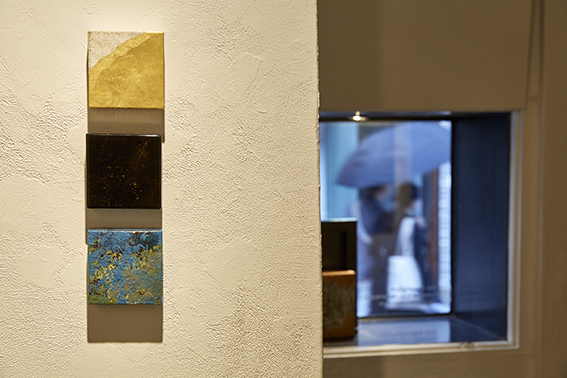
제작의 절차에서 옻칠은‘묘칠’(描漆)의 단계를 갖는다. 이것은 색을 얻기 위한 실험적 접근의 부단한 잠재적 선행들의 결실이다. 현대 예술의 색면 추상에서 볼 수 있듯이 색은 그림을 그린다 또는 칠한다는 뜻의‘묘’의 작용과 옻의 검은칠을 지시한다. 묘칠은 색이 일어나는 피움에 따른 색조의 현이며, 천연 광물에 대한 가공 및 분쇄에 따른 하양, 검음, 노랑, 붉음, 푸름, 녹음, 갈무리의 7 현을 말하며, 이들은 희(喜, 기뻐하는 것) · 노(怒, 성내는 것) · 우(憂, 우울해 하는것) · 사(思, 근심하는 것) · 비(悲, 슬퍼하는 것) · 경(驚, 놀라는 것) · 공(恐, 겁내는 것)이라는 7 가지의 정서 상태를 통틀어서 일컫는 조선 시대의 인문학적 이해들과 결을 이룬다.
생태 과학의 측면에서 색과 정서의 관계는 사람들의 정서를 접촉하며 예술의 속성으로 정서를 일으키는 능력이다. 색에 대한 정서적인 반응은 행복을 포함에서 즐거움, 웃음, 놀람, 자긍심, 그리고 감정의 승화를 지시하며, 언제 사람들이 감동하는지, 그들이 장기 기억에 전념하는지, 나아가‘태도’,‘맥락적 요인’,‘개인적 능력’,‘습관’을 비롯해 대인 관계적 행위들과도 연관된다. 현대 사회에서 사람들이 갖는 정서적 거리 및 거부의 심정적 상태들, 오히려 고립에서 편안함을 느끼더라도 이 느낌은 정서의 이해 면에서 생태학적으로 환경적 강등에 따른 공포, 슬픔, 그리고 분노를 말하며, 환경적에 대한 어떤 행위를 고무시킬 수 있다. 색의 작용은 삶과 환경에 따른 내재율로 마음의 그림, 환경에 대한 두드림과 같이 작업의 주체에게 펼침과 접힘을 중재하는 자기 조율의 기억을 공급하는 주요한 요인으로 규명되었다.
중국은 1980년대 이후 옻칠화를 직접적인 손을 이용한 수예(hanicraft)의 행위이자, 예술의 새로운 유형으로 간주해왔다. 이것은 회화와 공예, 예술과 기술의 조화 및 조합으로 본 것이다. 예술로서 옻칠화의 생산은 회화의 일반적인 원리와 옻칠만의 고유한 원리를 따른다는 점에서 그 특징은 자신들이 생산한 도구와 자생적인 옻의 자연적 성질에서 비롯한다고 본다. 중국적 옻칠화에 대한 디자인, 공예성 및 그림다움의 특징은 한국의 접지(medium_서로 다른 나무를 연결하는 의미에서)에서 한지의 마름과 다르듯이, 민족의 독특한 기술이다. 우리도 삼베나 면직물을 시침하고 마름하는 접힘과 붙임의 연속 작용이 있지 않은가. 중국의 연구는 옻칠을 고유한 자신의 문화적 발전으로 평가한다. 검음과 붉음은 옻칠에서 중요한 색으로 사용되었지만, 중국은 검은칠 이라는 언어적 표현을 흑단의 칠흙 같은 새까만 검정(pitch black)으로 표현한다. 붉음칠은 붉음의 끝, 짙은 붉음, 그리고 아스라한 주색의 붉음이라는 한자 표현을 사용한다.
금이나 은과 같은 금속 안료들 또한 옻에 사용된다. 이들의 반사적 성질은 푸름의 깨끗한 물색이라는 표현을 만들었고 다른 안료들에 독립적으로 스며들어, 반투명의 옻 고유의 칠과 중첩될 때, 다양한 색의 효과를 이끈다. 진주층과 계란 껍질은 옻칠의 색동을 풍성하게 하는데 사용되며 일반적으로 모방하기 어려우며, 도자에서 나타나는 자연스럽고 섬세한 매끄러운 빛남과 편린을 제공하여 표면 효과의 다양성을 만드는데 효과적이다. 스폰지나 공과 같은 도구들 또한 옻칠화의 특징인 자연성의 표면을 얻기 위해서 이용할 수 있다. 이 장인의 도구들은 자연의 패턴에 속한 어떤 짜임을 만든다. 옻칠화의 가능성에 대한 중국의 연구들은 인공물의 색과 자연스러운 표면, 광택의 방대한 적용을 설명한다. 그리고 이러한 연구들에서 우리는 한국의 칠이 어떠한 자연의 성질을 친근하게 자신들의 삶의 결로 수렴했는가를 질문하지 않을 수 없다.
위의 서술은 지금 여기에 자리한 작가의 작품에 우리의 궁리를 요청한다. 그 과제는 생태 예술이 제시하는 자연 및 사회 시스템에 거주하는 공존의 표현성에 대한 한국적 꽃피움이며, 생태 과학적으로 바다 및 해양에 관한 지표 프로젝트와 같이 우리의 자연 환경에 대한 지속과 변화에 대한 관찰과 성찰이 그것이다. 작품은 전통으로부터‘복원 예술’을 표시하는 인문학적 방향계를 요구하고, 생태 예술에서의‘트랜스-종 예술’(trans-species art)의 명시적 가능성을 시사하며, 근대 시문학과 현대를 잇는 서사들의 가지피움과 미술을 통한 한국 자연의 꽃피움을 기대하게 한다.
__________________________________________
Sánchez, Gilda Hernández.“THE STUDY OF MATERIAL CULTURE.” In Ceramics and the Spanish Conquest: Response and Continuity of Indigenous Pottery Technology in Central Mexico, 29–41. Brill, 2012.
David J. Curtis, Nick Reid and Guy Ballard, Communicating Ecology Through Art with What Scientists Think, Ecology and Society, Vol 17, NO,2, 2012,
최민우, 반 형태를 이용한 채화칠기 작품연구, 배재대학교 국제통상대학원, 칠예학과 칠예학 전공, 2011.
Sandra Simon, Systemic Educational Approaches to Environmental Issues : The Contribution of Ecological Art, Syst Pract Res, 2006, 19: 143~157
Qiao Shi-Guang, with Yu Xiao-Xing, On Lacquer Painting,Leonardo, Vol.17, No 1. 1984 pp.24~26
David K. Lewis, Convenion : A philosophical study, Harverd University Press, 1977.
김정은(Kim jeoung- eun) Damda Garden(circle), 2015~2016, 도록,
_____, 위아래를 보다, 도록, 2012~2013
Artist Statement
Life and death leaks from the fingers
Time comes throughout eyes
Relations ties together with mouths.
When I was with another artist
I was talking about pictures, she was talking about the working art
As soon I realized the gap,
I felt the term ‘artist’ being strange, and I looked straight where I am as a ‘drawing painter’.
Interpretation of words in a sentence has different range and meaning depending on the individual experience level.
The whole process of speaking and writing feels like nonsense to me.
I don't expect the way I describe in my language will be fully conveyed to others.
Artworks shown as one chunk of mass provides comfort to me.
The artwork titled ‘A Flower Bloomed on the Moon’ originated from this idea.
As I cross the ridges of life, I face emotions and thoughts that I never knew existed.
Did I already have the biggest changes in my traits?
.
.
.
It was not that the axis of my foundation was overturned, but that the realm of thought expanded and the depth of emotions changed.
My universe is divided into inside and outside based on my body.
universe inside me
universe outside me
The universe is not visually empty space, but a range of mass fully filled with something.
It is said that focus and concentrate are important to make artists self-esteem.
It is because by looking at the outstanding artwork, I can feel the concentrated thoughts and beliefs about the artists’ lives.
I am not yet obsessed with any of the tangible and intangible object.
Therefore, I draw what I can draw like I am a progressive artist, not a completely settled artist.
I present in an unknown world, and I walk on a path that is almost to a parallel that is difficult to reach.
I asked myself.
what do you want to draw?
I ask myself now.
what can you draw?
Lacquer painting_curation on restoration art and 'artifact' of trans-species
Hee-Jung, Shim (art critic)
Sonya Park (Translated by)
1. Confessions about the social life of ‘artifact’
I am an artifact, and was created by natural human who cautiously protects me to treasure the precious from being broken and being fracture. I am a vessel as being existing like as an shaped artifact that is able to be filled and be hold with life and death. My origin is a part of a tree like a glimpse found in Deokcheonri, Changwon, Gyeongsangnamdo in the Bronze Age in the B.C.4C. The white of my ancestors is the egg of life that speaks of the beginning of universe and the black is the majesty of the moon that illuminates the dignity of death. The epic poetry in the tradition of Korea is symbolized like as a traverse table indicating the mountain range, land, sea, river, and zone that belongs to the direction of the East, South, West, and North. It is said that life and death are one vessel, the tenacity and conformity of life flowing the weaving of warp and weft, that are called for ercting the fate of living.
In 2014, we were born in the righteous circle contained living and in the arrangement of the way of living. I was going to the fine art gallery or museum that was calling for naming the artcrafts and the folk, getting in a car transforting ‘artworks’. She called me and my family on all such occasions.
Cherry blossoms at Night, One Day, Scenery in jeju,
Early Spring, Spring Again, Gotjawal, A fragmented Scene,
A Hill with the rising sun, Oreum 1, Oreum 2, Oreum 3,
Mountain, Winter mountain, In the Forest Trail,
the way of going back, the way of coming back, Unfamiliar, Ruins,
Broken branches, Traces of a windbreak tree, Tree
The growth, As it is, Not overflowing, Raging, Heavy sun, Oriental,
The roaring, Heavy sun tropics, Tropical nights Still, Flowing,
The skin, Pit-pat, pit-a pat, Free from thought,
Icarus, hope, the hold,the white night sea,
Nowadays, our relatives argue about some news topics. Two activists from ‘Just Stop Oil’, an environmental group wants to object further driling fossil fuel and natural gas in the UK, poured tomato soup over Van Gogh's Sunflowers (1888). (CBS, 2022.10.17.) Relatives, lighter or heavier than us, thicker or thinner than us, are taking action
Fine art painting:
“It’s hard to be famous.”
“As the Covid-19 is over, many people come to museums and art galleries,
People are tired because of the Ukraine-Russian war, we would manage a lot of work to do.”
Sculpture: “Well, people have changed.”
Printmaking art: “It’s the Age of video art.”
Ceramics: “People say we are heavy.”
Wooden Furniture: “Some people like us.”
Photography: “The photo industry is going down.”
Clatter, the door opened. Some relatives have left and we were the only ones here. More precisely, we are with a curator who is like a court of hypotheses guiding to where we are headed for audience’s appreciation.
Curating 1: Sall we follow the convention? Is it craft?
Curating 2: Do I follow the example? I mean, is this painting in topology?
The artist also made printmaking. It is the plate.
Curating 3: There is a back side as well.
Is it a conceptualization about putting and woven something as installation?
Curating 4: One on the left, it should be hang like a picture.
No, no, one on the right.
Curating 5: Should the direction of the caption be created with light?
Shall we make it with color?
Curating 6: Is it presented in the same flowing as other works,
or in the different flow?
Curating 7: How much is it?
Curating 8: Is it natural? Shall we go with the artificial?
Curating 9: In what proportion? Do you mean the intention of realistic?
Is it the intention of abstract?
Which one would be more interesting?
Curating 10: Are the ingredients multinational? or just Korean?
Curating 11: Is it metaphorical dress? Is it lacquer?
How do you we identify the language function in this?
I follow the knowledge of the museum, a hall of social conventions and characteristics, and styles and cases as a cultural artifact. It is simple but also complex. Any 'thing', 'object-like', or 'even matter' knocking on the door of art museums cannot get away from the suspicious gaze that belongs to taxological attributional knowledge of museums and galleries curation. Isomorphic or heteromorphic eidos as the logical structure says, our qulification such as the dignity of the high class, the properties of the causal, IDentity of Thing(IDOT_object authentication system) that must be correspond to the regularity of Modernism and Post-Modernism, when we inculding you and me can be the usage of the function. This is our “The Social Life of Things” and sometimes we made guest appearance as an “objet” between “art and agency”. This is not the end yet.
Our ideal is to be a changeable and sustainable self-propulsion similar to a space shuttle. As far as I can, the isomorphic relatives who denied the above words and went to fall asleep on the land, after that, some of them might become changeable or unchangeable once until now, after people woke up. However, we could not even recognize the heteromorphic when we see their flexibility. Even if it were so, these take a position in a museum.
It can be possible for us as next generation to be placed on a site by exchaging or ciculating. What about our social life? How sad!
People love the world. The bigger the global hypothesis of curation, the more strange-looking we are here, and the people there. When a famous philosopher called it “a piece of driftwood” (George Dickie,1974, Art and the Aesthetic), we thought that our social life was able to be elevated into existence, but the time on the earth goes into being hot, lacquer trees that live in cool places has been disappeared one by one.
2. About the Blossom_Peeum of Lacquer Painting
Ecological art does not discover as a typical object. The artist tells a story that experiencing nature we confront with can be coming like coincidences of luck, flowing like the rhythm of life beyond our day life or rational understanding, when the experience occurs from being sympathized with nature. The encounter with oneself who acknowledges and approves the joy, anger, sorrow, and pleasure of self-recognition is the record by feeling the self which diversity of emotion that flows like nature, the memory of coexistence that engraves like natural process.
In general, lacquer painting of the traditional crafts comes from natural lacquer materials. The basis of lacquer painting is that not only Najeon lacquerware represents the beauty of the Joseon Dynasty, but also the harmony of Eastern ideology is established as an aesthetic custom. The harmony of black and red of lacquerware, and the hardness and elegance of wood grain like the breath of wood indicate ‘Gungli_궁리(窮理)’ which is our ancestors’ attitude and method regarding deeply studies the world of things relationship between color of lacquer and emotion. This perspective suggested the principle of approaching craftsmanship and craftwork, led by Van der Leeuw (1993)'s study in the second half of the 20th century, which in a broad sense reveals the relationship between the material and social change constituting craft. It also helps to understand the artist's work.
Their approaches are horizontal and vertical(geological) topology, taxonomy of parts and wholes of specific types(the partonomy=meronomy), and the sequence. To put it simply, the spatial phase system dictates the horizontal and vertical ratios of 'unfold' and 'standing', which are the way things are laid out. The taxonomic hierarchy refers to the relation between parts and the whole, and the continuity refers to the proportion or composition. This means a thin spread resembling the sun and moon in lacquerware, reaching the circular(盤_the basic) and modeling tetragonal box containing all kinds of things like form of a rice paddy or a farm. They are placed in the center of the modeling and the patterns and colors were re-contained as the image of nature.
The fuction of lacquer comes from water resistance, and has the effect of preventing decay and corrosion. The wisdom of the beginning using properties of nature is melted into technological opportunities for 'craftsmanship' along with the layer of development of society and use of artificial enhancement or evolutionary adaptation of objects conform causes between consumption and production and cultivate making procesure. This was the startpoint of craftsmanship in the 21st century, and the relationship between social and material change has converged into the aspect of change and continuity. If the craft technique is stabilized, it soon enter into a variation of the aesthetic sense that enhances usage and experience of the beauty. One says that working intrinsic rhythm by feeling the aestehtic would reduce the aesthetic sense in the direction of simultaneity indicating nowhere, if the form is satisfied and strengthened in the direction of maintaining the original form at some point.
The trajectory of the process of change and continuation of lacquer as the intrinsic rhythm of the aesthetic sense let the foundation for a specific way of fundamental elements of the historical tradition of craftsmanship arrage, and it suggest that measure of the relationship between art and technology can be implied as a cultural archetype illuminating the relationship between spirit and matter.
The three immanents, the phase of topology, the hierarchy of partonomy, and the continuity in lacquerware can be shared with consciously or unconsciously by the activity of artcraft field and also it can be regard as the specific and universal styles of lacquerware, as being assumed to be the sum of numerous opportunities for all stages involved in production and outcomes. Craftsmens have been being the variability of the potential for change in the manufacturing process and their opportunities regarded the initial method of any technique can keep to preservate the convention or the changes of customizing. Lacquer craftsmen call the inherent of color blooming-Peeum(spreading color), despite the constraints of social pressures or environmental restraints, these are active efforts of craftsmen. For this reason lacquerware is less affected by changes in different social scale, unlike other form of arts, and rather, the continuous action of the form of artifacts can be observed. The craftsman's waiting for the natural and structured state of the material, the procedural steps for the material and its transform process, is unique enough to distinguish the manifestation of natura principle flowing betwwen before and after with the artificial intervention. In addition, the final production is not only the result of various strategies of social consumption and production, but also the sequential step of the the artistic in that it is an individual's creative rhythm with respect to the aesthetic sense, moreover, that it can be posssoble for presumption that environmental conditions and the properties of craftsmanship can be infulenced by the various connections of relatives.
'Myochil' (描漆) is of the manufacturing process in lacquer painting. This is the result of constant potential action in the experimental approach to obtaining color. As can be seen in the color surface of modern abstract paintings, the color indicates the meaning of 'myo', which signifies ‘to paint or coloring’ as inward or outward significances invoving with working emotion as social convention and the feeling of the individual as a basement or ground in the meaning of the black layers of lacquer. Therefore, the meaning of ‘Myochil’ is like the string of instruments which may be thus interpreted, can be the meaing that the color express metaphorically emotion in a sence what emotion blossom. As general convention of the use of the word by the craftman, flower Peeumm, that is, expresssioning emotion can refers to the 7 colors of white, black, yellow, red, blue, green depended on processing and smithing of natural minerals and natura sources. They were joy(喜), anger(怒), depression(憂), anxiety(思), sadness(悲), surprise(驚), fear(恐) and they could be refered to the seven emotional states related to the understanding its humanities progressed on during the period of Joseon Dynasty.
In the aspect of ecological science, the relationship between color and emotion is the ability to touch people's emotions and generate emotions as an property of art. Emotional responses to color indicates the sublimation of pleasure, laugh, surprise, pride, and emotion including happiness, when people are emottional, whether they are absorbed into long term memory, furthermore, 'attitude', 'contextual factor', 'personal abilities' and 'habits' relate to interpersonal behaviors as well as. Even if people feel emotion such as confidence, emotional distance and refusal status that people can have in this society, even if rather in isolation, this feeling is inspired the subjec’s the action of fear, sadness, and anger caused by ecological status and understanding emotions in terms of environmental degradation. The efficiency cause of color is a major factor that supplies the subject status with a memory of self-regulation that mediates unfolding and folding, such as painting the mind and tapping on the environment, as a components according to life and environment.
China has viewed lacquer painting as an act of handicraft(手藝) and a new type of art since 1980s. It is seen as the harmony and interaction of painting and craft, art and technology. In that the production of lacquer painting as an art follows the general principle of painting and the unique principle of lacquer painting, its characteristics are believed to be derived from the tools they produced and the natural properties of the lacquer that they produced. The characteristics of design, craftsmanship, and picture quality of Chinese lacquer paintings are unique to the nation, just as they differ from the artifical manufacturing or drying of hanji, Korean paper, in Korean medium (in the sense of connecting and joining different trees). Isn't there a repetition of folding and gluing burlap or cotton fabrics? Chinese studies evaluate lacquer as a unique cultural development. Black and red were used as important colors in lacquer, but the linguistic expression of black lacquer is pitch black like ebony in Chinese character, for example, Red lacquer in Chinese character expressions are the end of red, deep red, and pale red.
Metallic pigments such as gold and silver are also used in lacquer. Their reflection qualities created the chines expression of “a clear watercolor” as Blue and permeated independently of other pigments, leading to a multi-colored effect, when overlapped with the inherent lacquer of translucent lacquer. The mother-of-pearl and eggshells are inlaid to enrich the color dynamics of lacquer, and are difficult to imitate, and are effective in creating a variety of surface effects by providing the natural and delicate smooth layers and flakes found in ceramics. Tools such as sponges and balls can also be used to achieve the natural surface characteristic of lacquer painting. These tools create a weave nature's pattern. Chinese studies on the potential of lacquer painting explain the vast application of artificial colors, natural surfaces, and varnishes. We can question how natural qualities of Korean layers converge into our lives in a friendly way.
The above description leads us to investigate about the artists’ work now in the menaing of ecological status. Its task is the Korean blossom_Peeum of the expression of coexistence inhabiting natural and social systems presented by ecological art, and eco-scientific observation of sustainability and change in our nature, such as ocean and coasts indexical projects. In connection with ecological context, the work requires a humanistic direction to indicate 'restorative art' from tradition, suggests the explicit possibility of 'trans-species art' in ecological art, and is a narrative that attaches early modern poetry and modernity, and makes people anticipate the blossom_Peeum of Korean nature through the blossom_Peeum in branches and art.
-
a blue dragon(靑龍) signifies mountain range of the East inculding height, foundation, room, mind, behind, and winnow, as that a red phoenix(Ju-zak_朱雀) represents mountain range of South including an well, goblin, wagon, two days, mercy, wing, and road, as that a white tiger (白虎)signifies the mountain range of the west writng, looking up, naming, finisging, engazing, and connecting, as that black tortoise(Hyunmoo_ 玄武) signifies the mountain range of the North.
* Reference
Jeoung-eun Kim, Damda Garden(circle)_artist book, 2015~2016.
_____, Looking up and down_artist book, 2012~2013.
Min-woo Choi, A Study of Chae-Hwa Ottchil-ware whoch using the shapes of tray, Department of Ottchcil Art Graudate School of International Business and Commerce Paichai University, 2011.
Sánchez, Gilda Hernández.“THE STUDY OF MATERIAL CULTURE.” In Ceramics and the Spanish Conquest: Response and Continuity of Indigenous Pottery Technology in Central Mexico, 29–41. Brill, 2012.
David J. Curtis, Nick Reid and Guy Ballard, Communicating Ecology Through Art with What Scientists Think, Ecology and Society, Vol 17, NO,2, 2012,
Sandra Simon, Systemic Educational Approaches to Environmental Issues : The Contribution of Ecological Art, Syst Pract Res, 2006, 19: 143~157
Qiao Shi-Guang, with Yu Xiao-Xing, On Lacquer Painting, Leonardo, Vol.17, No 1. 1984 pp.24~26
David K. Lewis, Convenion : A philosophical study, Harverd University Press, 1977.